An Outlandish Generosity
On Martin Shaw's Mythteller Trilogy

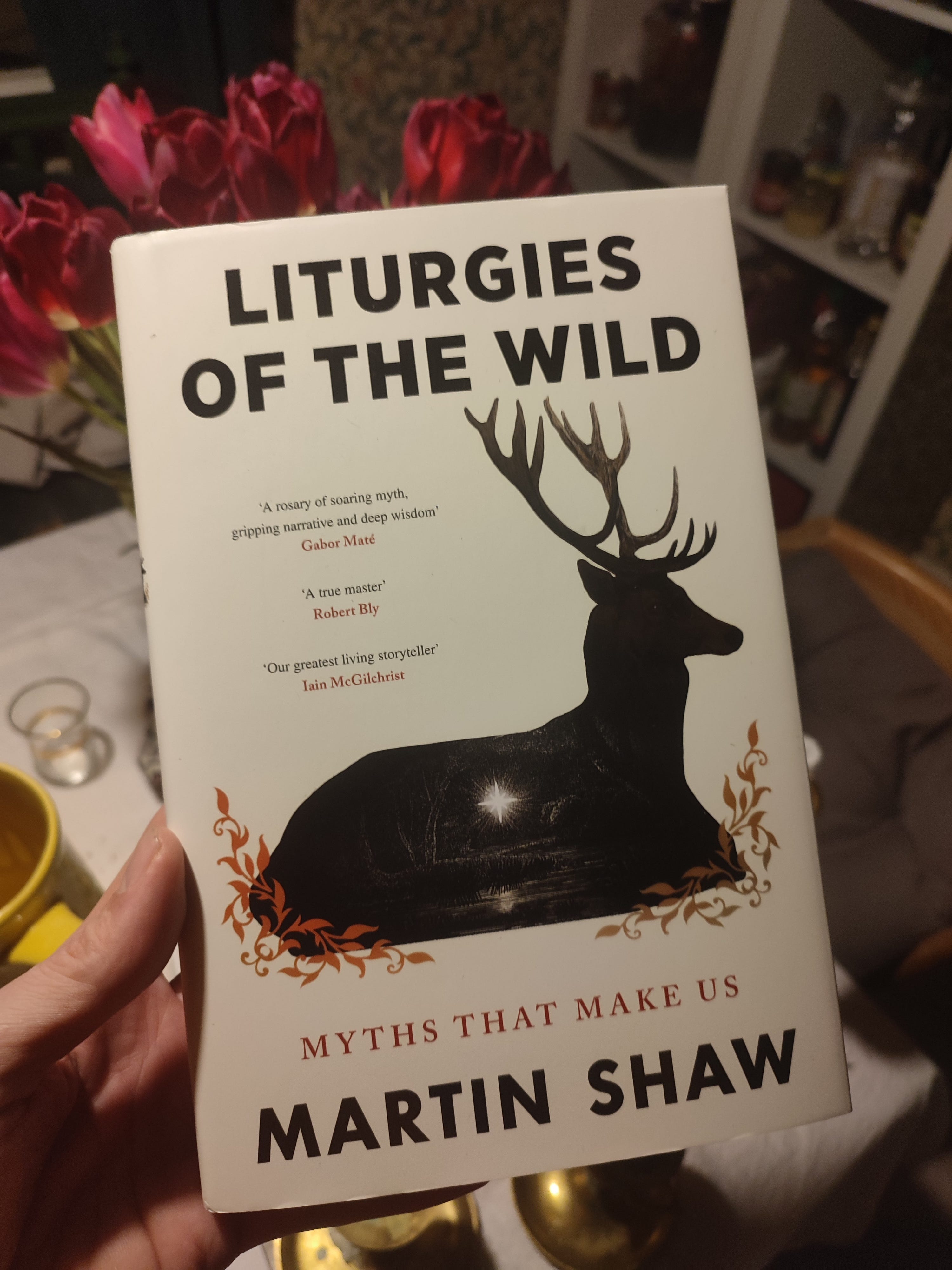
I’m in the full-on phase of writing a new book, but along the way, the plan is to share a few older essays which will be new to most of you – and today’s post is in honour of the arrival in the mailbox of Martin Shaw’s Liturgies of the Wild. We’ve going on for half a shelf of Martin’s books in the library here, but this latest feels like a landmark, one of those books that you’ve seen a writer working towards for a long time.
It took me back to 2014 and a review essay I wrote for STIR magazine about the Mythteller trilogy, or the first two volumes of it. Rereading this now, the part that feels strangest is my suggestion that Martin seemed ‘a little out of place in the formality of the written word’, but for many of us who knew his work back then, his natural home was beating out the hoofbeats of a story on his drum, riding an audience into the wild and back again.
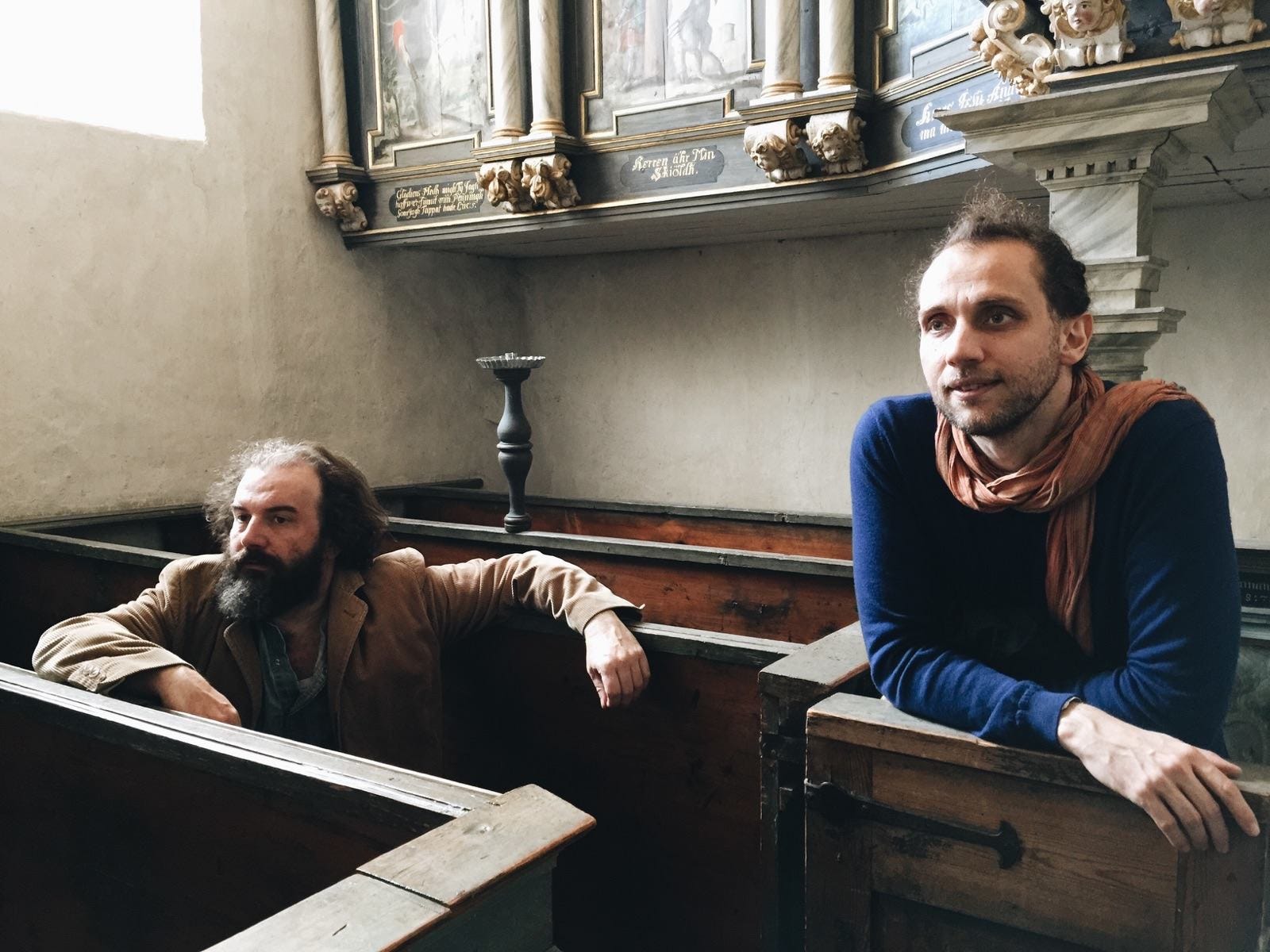
The photograph below was taken in the chapel at Wenngarn Castle on our day off during a short tour of Sweden, ten years ago this autumn. The tour was made possible by the role I had as leader of artistic development for Riksteatern, Sweden’s national theatre. That job title caused me to reflect a good deal on what ‘artistic development’ could mean, and among the list of answers that I ended up with, one of them had to do with the way that an artist’s work grows and changes over time. Watching Martin develop from a hard-touring storyteller into someone who will be remembered first and foremost as a writer has been a powerful example of that kind of development. Though he always seems to have had at least six other strings to his bow at any one time.
Martin’s back on the road just now, accompanying his new book into the world, so I wish him well out there – and I hope you all enjoy this glimpse of how his early work was sparking my thinking in the first few years of the Dark Mountain Project.
— Dougald
An Outlandish Generosity
(First published in STIR, Issue 7, Autumn 2014)
The condition of Capitalist Realism, according to the political theorist Mark Fisher, is defined by ‘the widespread sense that not only is capitalism the only viable political and economic system, but also that it is impossible even to imagine a coherent alternative.’ When I try to explain in daylight terms, rather than in the flicker of the campfire, why I think that Martin Shaw’s writings on myth, wilderness and wildness matter, I find myself remembering Fisher’s diagnosis. Then another passage comes to mind, from Mike Hulme, the founding director of the Tyndall Centre for Climate Research:
Climate change is not ‘a problem’ waiting for ‘a solution’. It is an environmental, cultural and political phenomenon which is re-shaping the way we think about ourselves, our societies and humanity’s place on Earth.
They differ in the focus of their arguments, but both Fisher and Hulme point towards a crisis in which imagination — or its failure — plays a central role. The grip of neoliberalism is tightened by its success in closing down our imagination, while the ongoing collision with planetary boundaries forces us into a confrontation with the stories we tell ourselves about the world and our place within it. To take these suggestions seriously would mean giving the work of culture an importance that goes well beyond the familiar deployment of the arts as a transmission mechanism for messages about change.
The past decade has seen no shortage of high-profile attempts to ‘tackle’ climate change as a theme in the arts. The results are generally disappointing. We get Ian McEwan writing an Ian McEwan novel about a philandering climate scientist. We get the National Theatre’s Greenland, in which storylines with all the depth of a soap opera play out against a background of melting icebergs and failing negotiations. Part of the trouble, I think, lies in the forms and conventions we have inherited from the recent past. Writers are schooled to grind sharp lenses of observation, to offer a microscopic attention to social detail, stereoscopic panoramas or endoscopic explorations of the individual psyche. There are some subjects, though, which can only be looked at indirectly, through the dark mirror of the shield with which Perseus approaches Medusa. As the shadows were driven into corners, by Enlightenment and then by electrification, we felt we had outgrown such ways of telling: stories that once belonged to everyone were sanitised, moralised and packed off to the nursery. Now, to our surprise, we find there is no position of detached observation left. As shadows lengthen over our whole way of living, we may once more be in need of the kind of storytelling that stalks truths so monstrous they turn our minds to stone if looked at straight on.
This is the territory in which Martin Shaw works. Like the trickster characters who inhabit his stories, Shaw is a trafficker between worlds: as likely to be found retelling medieval epics around a Devon campfire or guiding rites-of-passage retreats for inner-city teenagers on a Welsh mountainside as lecturing on the course in Oral Tradition that he devised at Stanford. Readers of these, the first two volumes of what promises to be a trilogy on myth, wilderness and wildness, will meet him in all these guises. At times a little out of place in the formality of the written word, some of his sentences seem to have been dragged through a hedge backwards, but they build into a feast of language and image, infused with an outlandish generosity. Here is rich food for the imagination: old stories from Ireland and Norway and Siberia, stories of witches and knights, bear kings and wild women of the woods, capped with a full-scale telling of the Grail epic of Parzival.
Running through both books is Shaw’s conviction that all of this is more than entertainment, romance or a relief from life’s hardships: that there exists, within stories like these, a kind of ‘mythological thinking’ that has its own rigour and that is of practical relevance to the largest and most urgent questions we encounter. Start out in this direction and, before long, you will pass the bounds of what it is respectable to take seriously as grown-ups in the kind of culture in which most of us grew up. Shaw is not remotely troubled by this: ‘If you don’t want to be Crazy Horse, Boudicca, or Pablo Neruda,’ he announces at the start, ‘stop reading now.’ Those afraid of looking foolish need not apply. Yet he insists on both the difficulty and the importance of bringing whatever wild insights we find out there back to the everyday world, the world which appears in these stories as that of the village or the court. ‘Don’t make a marginal life out of a marginal experience,’ he says, more than once, warning against the ‘smugness’ of an alternative culture in which we surround ourselves with like-minded souls.
Within the traditions on which he draws, Shaw distinguishes two modes of story, the pastoral and the prophetic:
The pastoral offers a salve, an affirmation of old, shared values, a reiteration of the power of the herd. The prophetic almost always brings some conflict with it — it disarms, awakens, challenges, and deepens. It is far less to do with enchantment and much more to do with waking up.
It is this second kind of story we need right now, Shaw suggests: the kind that takes us out of who we think we are, that allows for the emergence of something new. Yet one of the characteristics of mythological thinking is that such pairings are not reduced to oppositions: instead, if we look carefully, we catch sight of the mutual dependence between seeming opposites.
The old stories most often end with a homecoming, a feast, a celebration of the union of opposites. By contrast, if we go any distance along the wild paths to which Shaw invites us, our own return to the everyday is likely to be lonelier. We come back to a reality in which a myth is something to be debunked. Our experience of the possibility of other ways of knowing is met with incomprehension or disinterest. One of the strengths of these books is that they contain a great deal of experience of how to live between worlds — which is to say, between very different ways of understanding the world — without withdrawing, going crazy or burning out. That alone is worth the price of admission.
There remains, though, the larger question: what does it mean to appeal to the imagination, to the realm of fairytales, in a world of failing negotiations and melting icebergs?
One answer is that it provides a clue to the real nature of this crisis. The environmental movement has long tended to frame things in terms of the vulnerability of the planet. This is, in an important sense, a misunderstanding of what is at stake. Yes, we are living in a time of extraordinary ecological destruction, a mass extinction, perhaps the sixth in our planet’s history. But there’s the thing: the planet has been here before. Even the rapid shift in climate we have set in motion may not be unprecedented from a geological perspective. A million years from now, the planet will almost certainly be here, alive, in some as yet unimaginable ecological configuration. This is not to excuse the epic of destruction we have unleashed, but to try to understand it better.
What is at stake is not the planet, as such, but a way of living within it that we have created as a species, parts of which go back tens of thousands of years, while other parts are barely a generation deep, though we already struggle to imagine living without them. Our sense of loss at all the shadowed beauty being driven out of existence, our guilt, our still-remaining desire to feel proud of our place as a species — all of this exists in tension with our attachment to what we know and our sense of powerlessness within the structures we have built. These forces play out within us and on a planetary scale.
To understand the relationships between the inner and outer worlds that define the crisis, something like the subtlety of mythological thinking is required, its ability to dance with paradox and its openness to surprise. And perhaps, even now, there remains within the stories the capacity to make those relationships anew. For as Shaw says, that has always been the power of story: to ground us in such a way that a universe becomes a cosmos.
A Branch from the Lightning Tree and Snowy Tower are available direct from Cista Mystica Press.
Liturgies of the Wild is out now from Penguin.
Thanks for posting this essay, which fills in several gaps in my understanding of the recent narrative on climate change (or whatever we should call it) — I came to the story late in the day. And thanks for the photo from Venngarn, a Swedish castle which to my shame I have never visited. Yet!
I followed the link to the Liturgy of the Wild, and found in the book description, "to encounter Christ as the ultimate, transforming story." It sounds like he has accompanied Paul Kingsnorth into a deep version of Christianity. Unfortunately, for some of us, this is really quite alienating. With all due respect to Mr. Jesus, who seems like a very wise and nice man, this conflation of the mythological disenfranchisement of the modern world with the mythos of Constantine's religion makes it difficult or even impossible for some of us to pick up their books with an open mind. Sorry, but I think I'll decline to read this book.