Making Special ≠ Making Scarce
Thinking with Ellen Dissanayake about art and being human

Apologies to anyone who was planning to join us here in Östervåla on Sunday for an event with Helena Norberg-Hodge. We’ve had to change plans and so, instead, I’ll be in conversation with Helena at a screening of The Economics of Happiness on Wednesday (10 June) in Stockholm. Details and tickets here.
Look out for more news soon about gatherings here and elsewhere in early September to mark the centenary of Ivan Illich.
Ten days ago, I sent off the manuscript of the new book to my publisher. As the season of writing and revising came to an end, Anna and I moved into hosting our first online series in over a year. Over five weeks, we have 180 participants from multiple continents, the youngest in their teens and the oldest in their nineties, gathering in larger and smaller groups around the theme of “practice”. In their company I get to chew some more on questions I’ve been writing about.
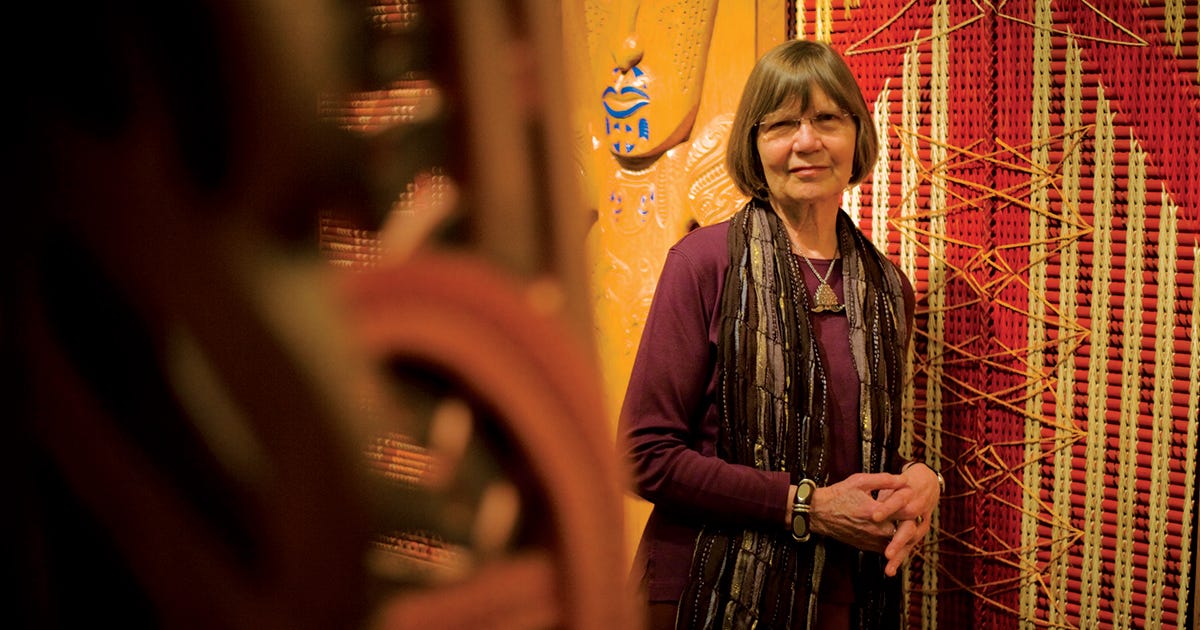
One thread that links the book and the series is Ellen Dissanayake’s work on art as behaviour. Dissanayake has dedicated a lifetime to studying the arts through an evolutionary lens as a distinctive behaviour of the human animal. It’s one of those cases where someone makes no attempt to build an academic career, but simply follows a hunch over decades, creating a body of work that runs at a strange angle to any established discipline. And although I’m not generally drawn to evolutionary explanations of human behaviour, there’s something about her work that I find compelling in multiple ways.
First, the sheer volume of material she draws together should demolish the persistent idea of art as a crowning achievement of human civilisation, a sophisticated layer of activity at the top of a Maslovian pyramid, a luxury to which we dedicate ourselves once the more fundamental layers of human needs have been taken care of. Rather, the activities we recognise as art are ubiquitous, woven into every example we have of humans being human together.
From the Darwinian perspective with which Dissanayake is working, the distinctive and seemingly universal character of this behaviour suggests that it is an evolutionary adaptation: a behaviour which has made a difference to the chances of creatures like us staying alive, reaching adulthood and having children who also live to adulthood.1 Again, this offers a counter to the idea of the arts as a luxury: if Dissanayake is on the right track, then the behaviour of art literally makes a life and death difference to creatures of our kind.
So what is the essence of this behaviour? After considering various ways of describing it, Dissanayake landed on the expression “making special”. The thing that marks out humans is that we “intentionally shape, embellish, and otherwise fashion aspects of [our] world to make these more than ordinary”. We take a colour, a pattern, a sound, a gesture, a word and lift it out of its everyday context, the setting in which we find or come up with it, and use it in other ways.
Here, I can’t help going beyond what Dissanayake says, because I’m tempted to say that we make worlds together through this behaviour, layered worlds that are woven with meaning. And, further, that the adaptiveness of this (in evolutionary terms) is suggestive of truth: this layered, patterned, meaning-riddled way of inhabiting the world and making it habitable is a better fit for the reality in which we find ourselves than if we attempt to inhabit it as flat and meaningless. And I take it as the mark of modernity that, in contrast to just about every other way of being human together we know about, there has been an attempt to inhabit the reality in which we find ourselves as though it were flat and meaningless.
But that opens a sizeable can of worms, some of which go wriggling through the pages of the book I’ve just written, and others I’m saving for the next book.
For today, I wanted to share a couple of notes on this matter of “making special”. Because the conversations Anna and I are having with participants have brought into view a couple of misleading ideas about “specialness” that haunt the ways of being human that have been taken for granted around here lately.
One version of this is “making special” as “making perfect”. Anna speaks about the debilitating effect of the pressure to make things “Instagram-perfect” – and the quietly radical practice of inviting people into a messy house! If we’re stuck with an idea that for things to be special, or simply good enough, we have to make our lives and our homes look like a photo shoot, then our ability to be human together grinds to a halt. The specialness worth having isn’t captured through a camera lens, it arises out of shared experience – but much of the aesthetics of advertising that developed through the twentieth century was an attempt to evoke this sense of specialness visually, on the page or the screen, until these synthetic substitutes colonised our imagination, leaving us neurotic about our messy human reality.
The other version I’ve been thinking about is “making special” as “making scarce”. Again and again, from different angles, I find myself returning to the production of scarcity as the paradoxical tendency of modern industrial societies. There’s more on this, too, in the new book – but for now, I want to point towards the opposite possibility: that we have the conditions for an abundance of “specialness”, precisely because of the thing Dissanayake is getting at when she identifies “making special” as the distinctive behaviour of the human animal.
In the past two days, I’ve heard participants talk about their experiences telling stories to classes of young children, singing to the dying, learning to care for patients in general practice and working with mothers around the birth of their children. In each case, there was a clear sense of showing up in a way that recognises and contributes to the specialness of what is taking place, here and now, in a given situation, and also a recognition that many of these situations are more or less universal. Another participant spoke about a culture of traditional music in Scotland and the creation of higher-education courses training technically brilliant musicians, but where the professionalisation of an artistic practice detaches it from the embedded, relational field that is the source of what matters most in this culture. This latter example gives a glimpse of how scarcity is produced and how attention is drawn away from the everyday specialness – the extraordinary ordinary, as my old friend Anthony McCann would say – and into a coupling of specialness with exceptional, scarce gifts.
These are themes that have been on my mind a lot and I’ll look forward to exploring further in public conversations, down the line, but I wanted to share these notes in the meanwhile. If we’ve lost the knack of “making special”, or lost confidence in this as a capacity that all of us have, then there are reasons for that, historical patterns that make sense of how we ended up here. But to the extent that Dissanayake is right to locate this capacity on an evolutionary level, that suggests that it is still there, still part of the kinds of creatures we are, and the seeming scarcity is artificially produced.
To be continued…
Thanks for reading and for supporting my writing by sharing, commenting, taking out paid subscriptions and in all kinds of other ways. I hope to see a few of you in Stockholm next week!
Apologies to any biologists reading, I’m sure I’m summarising sloppily here, but if you’re curious then take a look at What Is Art For? and Homo Aestheticus, Dissanayake’s first two books.
This quote also applies to artists who aren’t interested in PhDs or academic approaches to their arts practice:
“where someone makes no attempt to build an academic career, but simply follows a hunch over decades, creating a body of work”
Also sounds like 'photography' - taking something out of its everyday context and using it in other ways.