The Illich Archipelago
Mapping the people and projects at work in Ivan's footsteps

These past weeks, it has been a joy to hear from friends and strangers who are joining to mark the centenary of Ivan Illich. The map goes on filling with gatherings in different corners of the world – and, thanks to Gottfried Schmuck, there’s now a German translation of the invitation. If you’d like to help translate it into other languages, let me know.
Today, another kind of map: a sketch of the people and projects I’ve come across who are taking up Illich’s call for “research by people”, vernacular learning, convivial gathering and questioning the most taken-for-granted assumptions of modernity.
(There are enough images in this post that it may overrun your email client, but you can read the whole thing on Substack by clicking the title.)
Aware of the hour, no temple standing within sight,
I pushed my table out to sea and, siddur of pearl and rung
upon my lips, went fishing for flotilla.
After I wrote in memory of David Cayley and the trilogy of books that grew from his friendship with Illich, I heard from Judy Stoffman who was writing David’s obituary for the Toronto Globe and Mail. She wanted to know more about the Illich-related gatherings in Europe that he had been part of in recent years.
As I was replying to Judy’s questions, it struck me that my response might be helpful to others trying to find their way into these patterns of ongoing activity. So what follows is an expanded version of the notes I sent her. It comes with gratitude to Judy for the questions and with an invitation to others to fill in the gaps in my knowledge.
Here is the run of questions that Judy sent me:
What is the name of your organization – if it has one – of those devoted to Illich’s thought? How many of you are there and how do you join? How often do you meet? Do you read and publish scholarly papers after the meetings? Are the members mainly British or from all over Europe? Does the organization have a religious purpose or character?
David did not send his children to school. Do you know if some members of this European organization try to live out Illich’s precepts, as he did – would this be one of the purposes of the organization?
On Organisations
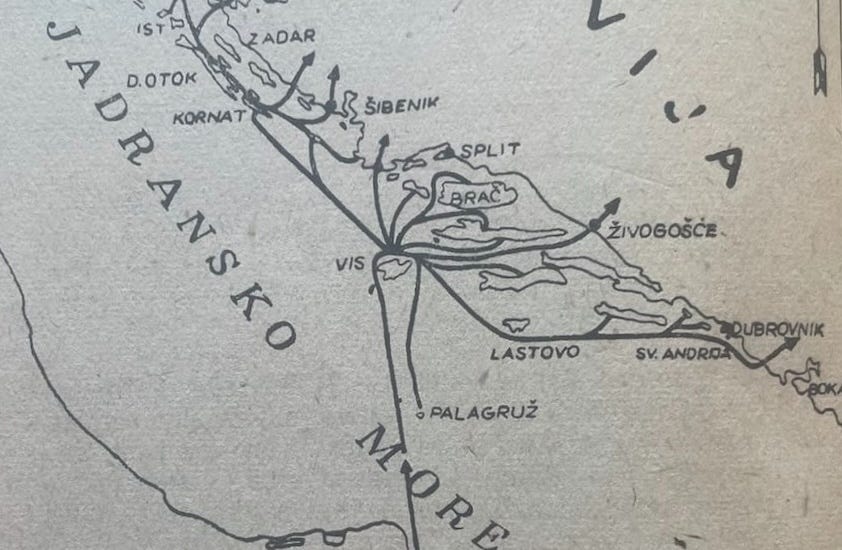
There is, I explained, no single organisation dedicated to Illich’s thought, but something more like an archipelago of people and projects. (Perhaps the better image is a flotilla, as Andrew often uses it: a flotilla of tables, moving loosely in alignment, each capable of making its own detours.)
The projects that I’m aware of include:
Thinking With Ivan Illich – “A platform for participants who want to ‘think with Illich’ and discuss ideas, share references, and deepen understanding. Thinking with Illich means heeding his call to question modern certainties to discover ways of living within limits shaped by natural thresholds” – created by Isabelle Cedotti and Neto Leão in collaboration with two of Illich’s friends, Samar Farage and Sajay Samuel.
Conspiratio – an online and print journal that grew out of that collaboration, published annually, run in the spirit of “research by people” which Illich advocated, in contrast to “research for people”. (A more conventional academic journal – the International Journal of Illich Studies – ran between 2009 to 2021.)
Stiftung Convivial – a German foundation with a venue in Wiesbaden, set up by a group of friends including Gunhild and Uwe Poerksen, Marianne and Reimer Gronemeyer. Home to the Illich “Archive”, including a growing collection of his unpublished papers, books he drew on in his work, books written by his friends and co-conspirators, and others “in the spirit of, inspired by or in dialogue with Ivan Illich”. (The online databank of the archive can be accessed here.)
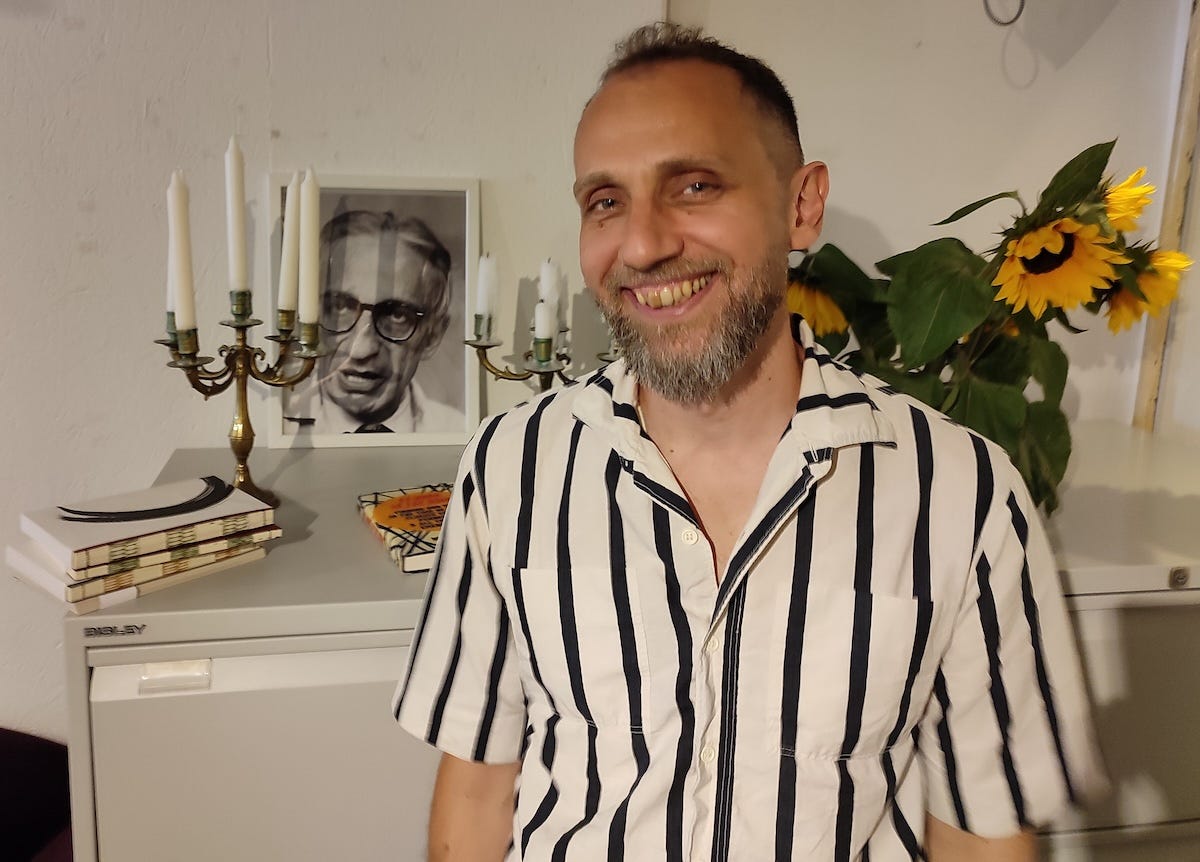
The Acervus Project – “A collective recovery of the works of thinkers and activists that emerged out of the constellation of conviviality surrounding Ivan Illich” – working in multiple languages, this project is assembling an open access online collection of Illich’s material (texts, interviews, audios, videos and more) and the remarkable range of publications of the Centre for Intercultural Documentation which Illich and his friends ran during the 1960s and 1970s. (It will launch officially later in the year.)
The Island School of Social Autonomy – “a place for imagining, experimenting with and cultivating forms of knowledge-production and knowledge-sharing for the ‘age of extinction’” – based on the Croatian island of Vis, close to the island of Braç, where Illich spent much of his early childhood. Members of ISSA are convening Islands of Conviviality, a travelling research project along the Dalmatian coast in September 2026 to celebrate Illich’s centenary.
The Foundation for Convivial Living – based in Vermont and created by the founders of Chelsea Green Publishing, the work of the foundation has included a series of films with Illich’s surviving friends and co-conspirators, made by Isabelle Cedotti and Neto Leão.
This is far from an exhaustive list – and I’d love to hear of other projects that belong on it. A map of the archipelago should also include online sources such as the one maintained by David Tinapple, where I first encountered many of Illich’s unpublished talks and essays, the collection of David Cayley’s writings and recordings, and L. M. Sacasas’s Illich-infused newsletter, The Convivial Society
For my own part, I’d add The Dark Mountain Project and a school called HOME as islands within the wider archipelago, in as much as my work on both has been deeply shaped by Illich’s influence.
On Meetings
Illich’s friends continued to gather regularly in various parts of the world in the years after his death. The Denken Nach Illich/Thinking After Illich site holds traces of some of these gatherings from the period between 2002 and 2013, along with texts by his friends and a collection of obituaries.
I first found my way into these circles when I travelled to Cuernavaca, Mexico for a meeting in 2007 to mark the fifth anniversary of his death.
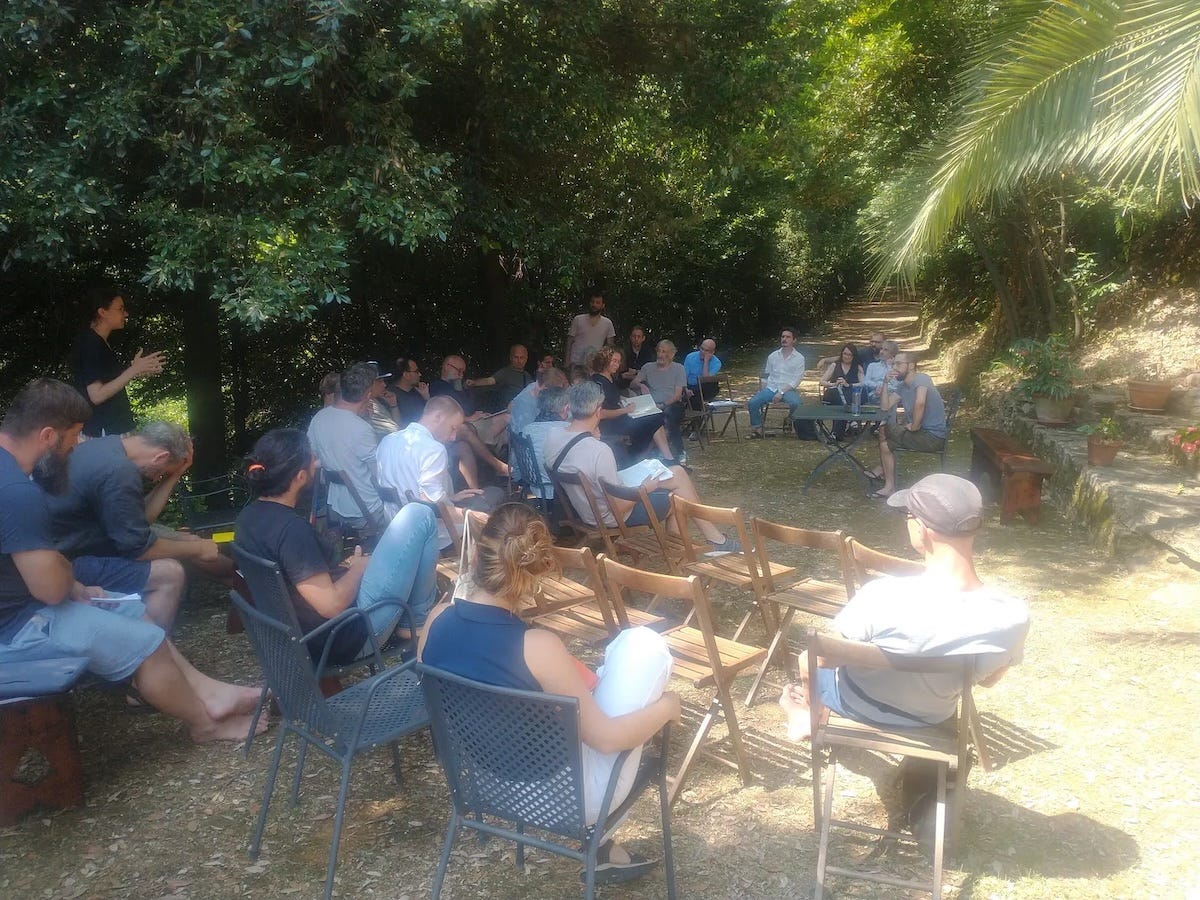
In recent years, these ongoing meetings have included an annual gathering in Europe, organised by those involved in several of the projects listed above, and connected to the Conspiratio journal. The 2024 meeting took place in Wiesbaden and Friesenheim, Germany, and in the past two years meetings have been held in Lucca, Italy.
Those taking part in these meetings are a curious mixture – including theologians, artists, technologists, anarchists, conservatives, philosophers, historians, physicists and musicians – drawn together by a willingness to stay with the trouble of Illich’s thinking and the different paths down which we’ve found it leading us. There’s no unifying religious or ideological purpose. Participants in recent gatherings have come from Italy, Germany, Norway, Argentina, the UK, Spain, Switzerland, Greece, the US and various other countries, with no one nationality predominant. They include those who knew Illich personally and those who met him through his work.
These are not large events, but they have been growing in size. I didn’t make it to this year’s gathering in Lucca, but I hear that there were over sixty participants. (For news of future events, I suggest contacting the hosts of Thinking With Ivan Illich.)
The spirit of these gatherings was evoked by one of the participants, Giorgio Agamben, when he proposed that we meet in “the garden of low studies”, an antidote to all the institutes of higher or advanced studies that scatter the academic landscape.
On Precepts
Another of Illich’s friends, John McKnight, remembered a conversation in which Illich described himself as “a proscriptive rather than a prescriptive thinker”. His role was to call into question – often in the strongest terms – the ways of doing things that were being taken for granted, rather than to prescribe what ought to be done instead.
So Deschooling Society was an argument about the counterproductivity of using schools as a means to organise societies, not a recommendation that individual families ought to engage in “unschooling” or “home schooling”. (Though obviously it had influence in such movements.)
All of which to say, I don’t think there are a set of “precepts” that could be attributed to Illich and that one could attempt to “live out”, so much as a set of ongoing questions that may continue to speak to readers who encounter his work. If you find yourself on the hook of one or other of those questions, it can certainly end up shaping the course of your life, and I’d say that’s the case for most of those I’ve met through the various gatherings and projects already mentioned.
Particularly among the younger generations drawn to Illich’s work, there’s a desire to find ways of creating lives and projects which might be more of a vessel for the kind of rigorous, open-ended enquiry which Illich pursued with his friends than the academic institutions inherited from the recent past, outside of or on the edges of existing institutional structures.
Here are a couple of further examples:
The Great Lakes Institute of Public Humanities – “A Garden and a Library” – organised by Philippe Mesly (whom I met at the Lucca gathering in 2025) and Julia Henderson, the Illichian influence is clear in the emphasis on “research by people” and “vernacular modes of learning and thinking”.
The Convivial – “a community symposium” and “civic learning space for imagination, ecology and place-based research & arts” in Penryn, Cornwall – created by Sophie Craven, inspired by a lecture on Illich and conviviality which she had heard Valentin Gerlier give at Schumacher College.
Some Afterthoughts
In beginning to chart these Illichian waters, it strikes me that our little flotilla may be converging with a wider movement of those seeking refuge from institutional counterproductivity. Earlier this week, reading John Inazu’s interview with Chad Wellmon about his book, After the University, I was struck by this passage:
We have absorbed this idea that a good practice becomes legitimate only when it scales. We assume eight or nine people are not enough. It needs to become a national network, and then a larger organization, and then it needs staff, branding, assessment, and influence.
I now think that assumption is pernicious.
The next day, I noticed Ashley Fitzgerald’s conversation with Jacob Hundt about Microcolleges. And running in the back of my mind have been a couple of Justin Smith-Ruiu’s recent comments:
I have had conversations these past months with more than one American friend, all in elite institutions, who tell much the same story. Ten years ago they had to do their quirky creative public stuff on the down-low, hoping all the while it would not generate too much press. Now their deans are holding them up as shining examples of how to adapt to a rapidly changing world, and as models of what a scholar-thinker-intellectual in the 21st century might yet be.
It is time now … to begin building parallel institutions that can exert some real pressure, that can let the universities know just how deeply they’ve failed, by modeling a truer and more beautiful alternative.
I made an early exit from the world of “elite institutions”, around the time Mary Harrington and I were graduating from Oxford and her tutor said, “Ten years ago, I’d have insisted you stick around and do a doctorate, but the way things are going, just get your First and get out of here.” So it’s a curious thing, well into middle age, to see those who stayed the path arriving at thoughtful articulations of things I’ve tried to find a way of saying and putting into practice for much of my adult life.
It takes me back to a passage from Richard H. Roberts’s Religion, Theology and the Human Sciences that has accompanied me for twenty years:
Given present conditions, I believe that the future survival of fundamental truth-seeking, the production of knowledge and genuinely ‘owned’ university teaching, together understood as part and parcel of the total way of life, may well only be assured through cultural migration, and the creation of new, subversive and marginal institutional embodiments.
And to the first place I found a vision of what I was looking for, in Illich’s late text, ‘The Cultivation of Conspiracy’, where he tells the story of the various “thinkeries” that he and his friends had created over the years:
Learned and leisurely hospitality is the only antidote to the stance of deadly cleverness that is acquired in the professional pursuit of objectively secured knowledge. I remain certain that the quest for truth cannot thrive outside the nourishment of mutual trust flowering into a commitment to friendship.
To have washed up on the shores of the Illich archipelago as a young man, to find a welcome around the tables of its strange flotilla – this was one of the great blessings of my life. I’m curious how our experiences might weave with those steering by other constellations who find themselves today in similar waters.
Thanks for reading this instalment of Writing Home. As always, it comes with the acknowledgement that my work is made possible in no small part by the support of those of you who take out paid subscriptions.
For more news of the gatherings to mark Illich’s centenary, visit the Illich at 100 page on our school website. (Auf Deutsch.)
Thank you Dougald, for this rich and thoughtful reflection. What resonated with me most is the reminder that lasting change begins not with bigger institutions, but with deeper friendships, generous hospitality, and communities of trust.
Reading this from Ethiopia, I was struck by how naturally Illich's vision resonates with many African traditions, where wisdom and learning grow through relationships and shared life. A timely and inspiring invitation to rediscover the power of belonging, conviviality, and mutual learning. Fr. Kidus, Ethiopia
Hej Dougald,
The last paragraphs, about the thinkeries and the “quest for truth”, indeed reminds me of Lucca this year. A marvelous experience. Not least due the feeling of how that lively collection of characters gathered to “stay with the trouble of Illich’s thinking”, because doing so is beautiful, joyful and vivifying in itself. This in striking contrast to the atmosphere found at all those events people attend just to advance their academic careers, or to push a pre-packaged ideological agenda.
In respect to your point about Illich as proscriptive rather than prescriptive, and offering no precepts. That issue could be the basis for a good collection of articles some day. I agree that his work won’t tell you whether or not you should see a doctor, drive a car, or send your kids to school. But when it comes to the question of holding fast to a certain comportment towards life, two things stand out for me personally: 1) that Illich was perfectly right when he himself said that “the love of friendship, philia, as practicable under the social and symbolic conditions engendered by modern artifacts, has been the constant subject of my teaching”. 2) how, in 1969 he stated and then held to: “I decided long ago to hope for surprises until the final act of my life – that is to say, in death itself”.
Another thing, with some relevance to this. When reading the “powerless church” collection the other day, I was struck by how his early proposal for a de-clericalised church invokes an image that then comes back so much later, in his critique of ecologism.
That is, in 1967: “I foresee the face-to-face meeting of families around a table, rather than the impersonal attendance of a crowd around an altar. Celebration will sanctify the dining room; rather than consecrated buildings, the ceremony”
Then in Ivan Illich in Conversation, envisioning: “A sense of being able to celebrate the present and celebrate it by using as little as possible, because it’s beautiful, not because it’s useful for saving the world, could create the dinner table which symbolizes opposition to that macabre dance of ecology, the dinner table where aliveness is consciously celebrated as the opposite of life”.
In all, I take this not as precepts but as an authoritative commandment that thou shalt have lots of get-togethers with your mates to eat and celebrate and to do whatever. And to drink a lot of wine, of course - how better to induce that openness hospitable to surprise? (Joking, of course, but only in part…).
Mvh,
Oscar