Words Change Things
On the consequences of our ways of seeing and telling

Today, a new essay, written for Dan Thompson’s festival Words Change Things which runs from Thursday to Sunday this week in Margate. If you’re anywhere near Kent, I recommend getting yourself along!
Book news – I’m closing in on the final pages of the first draft. But I did enjoy stepping back for a day to write a one-off piece like this. As these things go, it includes some traces of what you’re going to find in the book itself.
There are still some places left for A Bit More Practice, the five-week online series Anna and I are hosting, which starts in just over three weeks’ time.
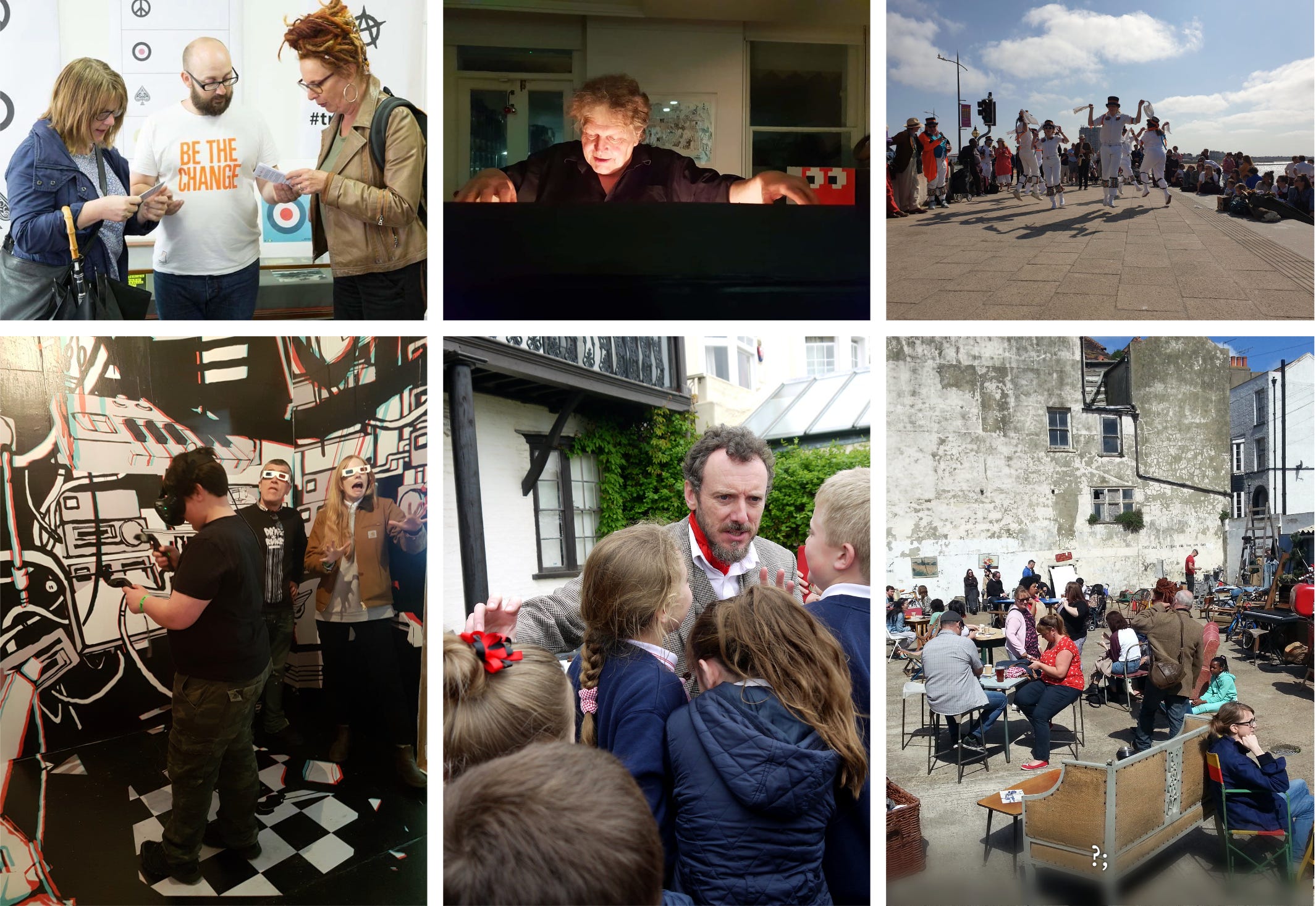
Meanwhile, enjoy the essay – and the pictures from Dan’s work!
DH
When you get to the end of this sentence, I want you to lift your eyes from my words for half a minute, let your gaze wander and notice whatever and whoever is around you.

You back with me? Good, now think about what happened there. What’s going on in the experience of seeing? The chances are, if you had to explain it, you’d talk about the light reflecting off everything and how the eye takes this in. You might even draw a diagram of a head in profile with a pair of lines converging on the pupil.
If you’re an artist or a neuroscientist, your explanation might diverge, but the default background understanding of the gaze is that we go around with a pair of lenses in the front of our heads, like walking stereoscopic cameras. This passive-receptive model of seeing is around four hundred years old. Before that, for many centuries in European culture, the background understanding was quite different. The gaze was something active, reaching out: the psychopodia, or ‘fingers of the soul’, brushing against whatever it lands on. If you entertain this strange thought for a while, you may find that it brings different aspects of the experience of seeing into focus. It says more about what happens when you catch a stranger’s eye, or the experience of being watched, than our familiar ways of understanding eyesight.
Place these two ways of seeing alongside one another, and what we have is not a refinement of objective knowledge, moving from a less accurate to a more accurate model, so much as two different stories about what it is like to have eyes. Each story fits some parts of the experience. Which story lies in the background of our common life will have consequences, subtle as they may be, colouring what happens when we meet each other, shaping the world in which we find ourselves.
The instrumental optics on which the story of the eye as a camera is founded go back to the work of the German polymath Johannes Kepler at the start of the seventeenth century. Several generations later, in the same part of the world, another innovation in seeing took place. This one involved forests and trees.
The princes of Prussia and Saxony were troubled: they needed wood for ships and they weren’t sure where the trees were or how big or whether there were going to be enough. They wanted better maps of the territories they ruled, a way to see and know the forests from above, and because of the age in which they were ruling, this gave rise to what would be known as ‘scientific forestry’.
To see a forest without having to go there, to know how many ships’ worth of timbers and masts you’ll get out of it, you have it put into a spreadsheet. The work was impressive, new tools and techniques for measuring and averaging and projecting had to be invented, and the result was a set of numbers in columns in ledgers, on the basis of which the forest managers were instructed to ‘deliver the greatest possible constant volume of wood’.
Of course, there wasn’t room for everything in the spreadsheet. The creatures who lived in the forest, the plants, the trees you can’t make ships from, the underground web of mycelium, the overground weave of activity of those humans whose traditional involvement with a local forest contributed to their livelihoods: all of this had to be left out, in order to focus on the outputs that mattered.
This new way of seeing turned out to be a two-step process. First, you map the forest into rows and columns; then you remake it to resemble the map. By the early nineteenth century, German foresters were planting trees in orderly formations, like soldiers lined up on parade. And to start with, these new model forests were startlingly successful. The trees grew strong and tall and straight, and the model spread around the world. (A special mention here for the Imperial Forestry Service, established under the British Raj in 1867, which hired German experts and spread their techniques throughout the Empire and beyond.)
It all worked so well, until it didn’t. And since the generations of trees are a good deal longer than those of humans, this only became clear after everyone involved in inventing this model of forestry was gone, by which time most of those working with forests had spent their whole working lives inside this way of seeing trees.
You see, the second generation of trees did not grow like the first, and the third generation gave a new word to the German language: Waldsterben, ‘forest death’. The full ecological story of what went wrong is complex, but the simple version is that those early trees had grown strong and tall by mining the soil built up by centuries of living forests. With all the useless, unimportant species cleared away, they got to take it all; only, on their own, they couldn’t give back what they took, couldn’t keep life moving, and so their strength came at the cost of the slow, unmeasured dying of the very ground from which they grew, which is to say the slow, unmeasured dying of the conditions for the ongoing life of their own kind.
Our ways of seeing and our ways of telling matter. How we describe the world, the frames we use to do so: these things have consequences. They determine, first, what falls out of view and out of mind within the world as it stands, and then how the world gets remade over time.
I tell you this because I have come to believe that something very like what happened to those forests has been happening to us. Over generations, as a consequence of certain powerful stories and ways of seeing, we have mined the soil of our common life; a soil that was older and deeper than the modern structures of the market and the state. At the back of much of what we’re living through today there lies a process which resembles Waldsterben: a quiet, unmeasured dying of the soil of culture and community and commons.
If you have the headspace to follow a story of the kind I’m telling here, then the chances are that you, like me, find yourself in a relatively sheltered position right now, yet few of us are so sheltered we don’t feel the cold winds of precarity blowing. The worst part is that to see this process I have been describing doesn’t offer any immediate ways to fix it. I don’t think we’re dealing with something ‘fixable’ here, or not in any of the ways we usually think of fixing things. I think we’re dealing with the ending of a world, which is to say the ending of a certain way of seeing and telling, a certain way of describing and framing and determining what matters. In some important sense, the good years of the world into which we were born are behind us, the years when the things it valued still grew strong and tall. Now, the easy wins are over: not just the low-hanging fruit, but even the upper-middle branches are picked clean, and no AI boom or Bitcoin scam will put it right, no referendum or insurgency. Even taxing the billionaires won’t get this story back on the road, which is not to say that I’m against it.
So what’s worth doing, then? Well, how long have you got – because I’m writing a book that brings together as many clues as I have found so far. But start by noticing the power of words and stories, and the way this power works by shifting attention, shaping what comes into view and what gets hidden. Use your words to find each other, to practice kindness, to give attention to things that were belittled in the world-story into which most of us were born: care, beauty, meaning. Look for the work that feeds us and find ways to get involved in this. Notice the deep wells of good will and lively pragmatism on which humans are capable of drawing when we come together to do things for reasons that don’t conform to the one-track logic of the market and the state. Relearn the art of invitation, make friends with somebody you disagree with, tend a patch of ground; try praying, even if you can’t quite say who to; learn a song, listen to a child, share a meal with your neighbours and set an extra place for the stranger who might arrive at your table. Be free with your joy, be true to your grief and be careful where you put your anger. Carry words like seeds and scatter them where you go. Hold onto the suspicion that, even now, in the land and in your bones and in the bones of every stranger you ever sat next to on a bus, and even in the bones of the politician lying to you on the screen, there is a great un-worded longing to come alive. And maybe, together, in scattered groups and across unlikely alliances, we can start to make good things out of the ruins of broken systems.
When you get to the end of this sentence, I want you to lift your eyes from my words for half a minute, let your gaze wander, noticing whatever or whoever is around you, and see if anything has changed.
For more of the story of the history of seeing, start with Ivan Illich, ‘The Scopic Past and the Ethics of the Gaze’. The history of scientific forestry is the subject of the opening chapter of James C. Scott’s Seeing Like a State, and the instruction to ‘deliver the greatest possible constant volume of wood’ is quoted from Georg Ludwig Hartig’s Grundsätze der Forst-Direction of 1803.

This really touched me, Dougald. Thank you. I work in the field of 'narrative change', which is all about story and frames and the way we manifest this complex, infuriating, beautiful world into language (I worked with Tom Crompton at the Common Cause Foundation for 5 years - perhaps you know of it?). But a frustration I feel daily is that this work is often geared towards finding some magic sequence of words to persuade someone to think in a particular way in order to do a particular thing which we, as change-makers, deem somehow 'better' than whatever they were thinking or doing before.
Although I can see the power in this sometimes, it often feels to me far too narrow for the depth of the moment we're living through. The sickness we're experiencing, if I can call it that, isn't fixable by better messaging, but perhaps there's some healing to be found in cultivating a world-story (as you call it) that can soothe how we relate, what we notice, what we worship, what we fear and what we do when we're feeling scared etc.
What moved me in your piece was the reminder and beautiful articulation that stories shape the horizons of perception, and deepens my feeling that the work called for in these times is less about persuasion and maybe more about inviting reflection, encounter, grief, beauty and care. I also feel strongly that stories/narratives do not become part of us through language alone, or through the media we consume, but are reinforced through our lived experience of the institutions we interact with and the systems we move through everyday that can subtly teach us how the world works and what matters.
I'm signed up for A Bit More Practice - looking forward to it :)
So beautiful, so inspiring, Dougald. To get metaphysical, it seems we do create the seemingly physical world--it renders--as we see/experience it.
I am especially touched by "Be free with your joy. Be true to your grief. And be careful where you put your anger."
Yes, there is a "great unworded longing to come alive" in our very bones, and I believe it happens when we drop the shame and guilt of being human and recognize our true purpose in life's ecosystems, which is to see and create beauty. Thank you for your part in this.